Published
- 6 min read
Why Are We Still Using Markdown in 2026?
Why Are We Still Using Markdown in 2026?
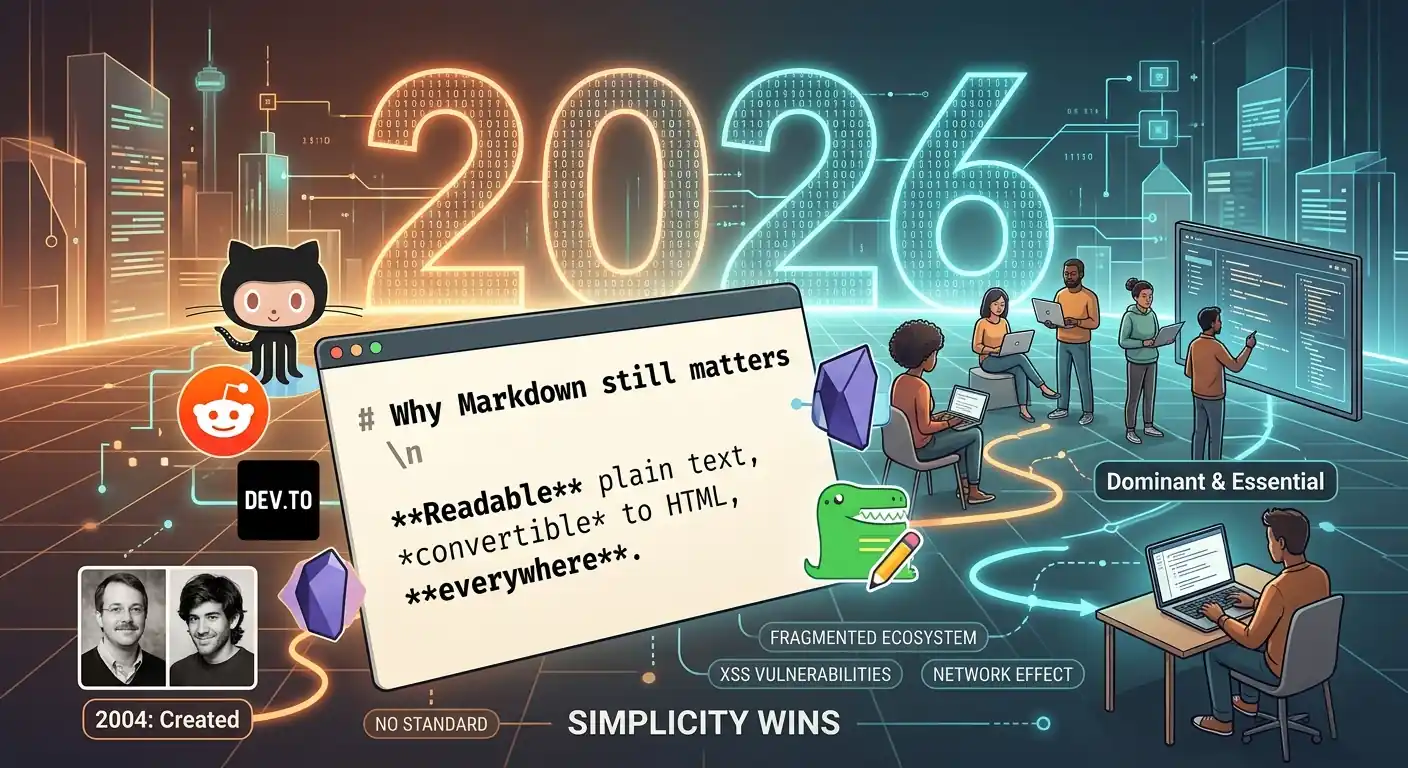
In 2004, John Gruber and Aaron Swartz created Markdown with a deceptively simple goal: make it easier to write for the web without needing to know HTML.
Twenty two years later, Markdown is everywhere. It’s how developers write README files, how writers draft documentation, how note taking apps store your thoughts, and how platforms like GitHub, Reddit, and dev.to format content.
But here’s the uncomfortable question: Is Markdown actually good, or have we just settled for it?
This isn’t a hit piece on Markdown. It’s a genuine examination of why this 2004 formatting syntax still dominates in 2026 and whether that’s a sign of its brilliance or our collective stagnation.
Índice
- The Genius of Markdown’s Original Design
- The Problems Nobody Talks About
- What Are the Alternatives?
- Why Markdown Won Anyway
- The Future: What Comes After Markdown
- Conclusion
The Genius of Markdown’s Original Design
To understand why Markdown persists, we need to appreciate what made it revolutionary.
Simplicity Above All
Markdown’s genius was its deliberate simplicity. Gruber designed it to be:
- Readable as plain text: No tags, no formatting symbols cluttering the content
- Convertible to HTML: One tool, one output
- Writers-friendly: You write like you’re drafting an email
       # This is a heading

**This is bold**

- This is a list item
  [This is a link](https://example.com)
Compare that to the HTML equivalent:
       <h1>This is a heading</h1>
<strong>This is bold</strong>
<ul>
	<li>This is a list item</li>
</ul>
<a href="https://example.com">This is a link</a>
For a writer in 2004, the choice was obvious.
The Network Effect
Markdown spread because of GitHub. When GitHub launched in 2008 and made Markdown the default for README files, it created the world’s largest Markdown ecosystem overnight.
Today:
- Every repository has a README.md
- Every GitHub issue and pull request uses Markdown
- Millions of developers write Markdown daily
The Problems Nobody Talks About
Markdown’s dominance doesn’t mean it’s perfect. In fact, several issues have plagued it since the beginning.
Problem 1: There Is No Markdown Standard
This is the elephant in the room. Markdown has no official specification that all implementations follow.
The original Markdown syntax from 2004 has been extended by:
- GitHub Flavored Markdown (GFM)
- CommonMark
- Markdown Extra
- MDX
- Dozens of other variants
The result? The same file renders differently depending on the parser.
       # This might work

## In this parser

### But not in this one
Some parsers support tables, others don’t. Some support task lists, others ignore them. Your Markdown is not my Markdown.
Problem 2: The Ecosystem Is Fragmented
Because there’s no standard, developers have built competing tools:
| Tool | What It Does | The Problem |
|---|---|---|
| VS Code | Markdown preview | Extensions behave differently |
| HackMD | Collaborative Markdown | Sync issues |
| Obsidian | Markdown-based notes | Vault portability problems |
| Docusaurus | Markdown sites | Complex setup |
Lock-in is real. Your notes in Notion aren’t Markdown. Your notes in Obsidian are Markdown, but try moving to Logseq or Bear.
Problem 3: Advanced Use Cases Break the Model
Markdown was designed for prose and basic formatting. When you need more, it starts to crack:
<!-- Trying to do something complex in pure Markdown -->For technical documentation, you end up embedding HTML anyway:
       <details>
	<summary>Click to expand</summary>
	This works, but now you're writing HTML inside Markdown.
</details>
At that point, why not just write in a format designed for complex content?
Problem 4: Security Vulnerabilities
Markdown parsers have been the source of real security vulnerabilities:
- XSS attacks via malicious links
- HTML injection through crafted input
- Path traversal in some implementations
Because parsers handle HTML differently, some render dangerous content that others block.
What Are the Alternatives?
If Markdown has these problems, what should we use instead?
Alternative 1: AsciiDoc
AsciiDoc is what Markdown wants to be when it grows up.
       = Document Title
Author Name <[email protected]>

== Section Title

Here's a paragraph with *bold* and _italic_ text.

[source,ruby]
----
puts "Hello, World!"
----
Pros:
- True standard (AsciiDoc Specification)
- Native tables, includes, and advanced features
- Excellent for technical documentation
Cons:
- Steeper learning curve
- Less adoption than Markdown
- Fewer tooling options
Alternative 2: reStructuredText
Popular in the Python world, reStructuredText is powerful but verbose.
       ==============
Document Title
==============

This is a paragraph with *emphasis* and **strong** text.

.. code-block:: python

   print("Hello, World!")
Pros:
- Used by Python’s documentation (Sphinx)
- Extremely powerful for technical docs
- Built-in cross-referencing
Cons:
- Ugly syntax
- Limited adoption outside Python community
- Complex build process
Alternative 3: MDX
MDX extends Markdown with JSX components.
       import { Chart } from './components/Chart'

# My Document

<Chart data={salesData} />
Pros:
- Markdown + React components
- Great for documentation with interactive elements
- Used by content platforms
Cons:
- Requires build step
- Not plain text anymore
- Limited editor support
Alternative 4: Plain HTML + CSS
Some argue we should just use the web’s native technologies.
       <article>
	<h1>Document Title</h1>
	<p>This is a paragraph.</p>
</article>
Pros:
- Full power of the web
- No parsing ambiguity
- Every tool supports it
Cons:
- Verbose for writers
- Steep learning curve
- No lightweight editing experience
Why Markdown Won Anyway
Despite its flaws, Markdown dominates. Here’s why that makes sense:
1. The Network Effect Is Unbeatable
GitHub has over 100 million users, all writing Markdown. When everyone around you uses a tool, you use it too. This is Metcalfe’s Law in action.
2. “Good Enough” Beats “Better”
Yes, AsciiDoc is technically superior. Yes, reStructuredText has more features. But Markdown is good enough for 80% of use cases, and that 80% doesn’t need more.
3. The Tooling Has Matured
Look at the Markdown tooling available today:
- VS Code with Live Preview
- Typora, Obsidian, iA Writer
- GitHub, GitLab, Bitbucket all support it natively
- Static site generators: Jekyll, Hugo, Docusaurus, Astro
Once an ecosystem reaches this size, switching costs become prohibitive.
4. It’s Human-Readable by Default
Unlike HTML or XML, Markdown files are readable without rendering. You can read a README.md in a terminal and understand it.
This matters for:
- Code reviews
- diffs in version control
- grep searching files
- plain text editors
5. The Rise of the Markdown-First Workflow
Modern tools have embraced Markdown as the universal format:
| Tool | Role |
|---|---|
| Obsidian | Local Markdown notes |
| GitHub | Markdown repositories |
| Notion | Hybrid (exports to Markdown) |
| Astro | Markdown based sites |
| VS Code | Markdown editing |
Your Markdown files today will be readable in 50 years. Can you say the same about your Notion notes or Google Doc?
The Future: What Comes After Markdown?
So if Markdown isn’t perfect, what might replace it?
Possibility 1: A Standardized Markdown 2.0
Some are pushing for a unified Markdown specification that addresses the fragmentation. CommonMark was a step in this direction, but adoption remains incomplete.
Possibility 2: AI-Assisted Writing
What if your editor understood your intent?
[AI interprets: "add a table comparing X and Y"]AI tools might abstract away formatting entirely, letting you write naturally while the system handles structure.
Possibility 3: Structural Editors
Tools like Tldraw’s dev edgition or Canva’s Docs show a future where you manipulate structure visually, not through text.
Instead of writing:
       # Heading

Paragraph text
You’d manipulate blocks directly, with the text format being an export option.
Conclusion
Markdown isn’t the best format. It’s not even particularly good in some ways. But it’s good enough, everywhere, and established.
Here’s the pragmatic truth:
- For documentation and READMEs: Markdown is the de facto standard. Use it.
- For technical documentation with complex requirements: Consider AsciiDoc or reStructuredText.
- For notes and personal writing: Markdown gives you portability. Use Obsidian or plain files.
- For content heavy websites: Use Astro with Markdown/MDX. You’ll thank yourself later.
The question isn’t whether Markdown is perfect. It’s whether switching to something better is worth the cost.
In 2026, for most developers and writers, it isn’t.
What do you think? Is Markdown still the right choice, or have we been too quick to accept “good enough”? Share your thoughts below.
Related Posts: